Skipping attention blocks was the easy part

BLASST block-sparse attention plus one TMEM address swap: −41.9% attention-kernel time at 95% skip and −20% TTFT at 64K with accuracy above dense — an optimization worklog on a B200.
Implementing block-sparse attention took a week. Making it actually pay took a month of profiling — and the fix was moving one write address.
At long context, most KV blocks in attention prefill end up with post-softmax weights that are numerically negligible. BLASST (arXiv 2512.12087) is a training-free way to skip them: during FlashAttention’s online softmax, statistics you already have tell you, per KV block, that its contribution will vanish.
This summer at Modular I implemented BLASST in MAX’s FlashAttention-4-style
SM100 (B200) bf16 prefill kernel. The skip mechanism worked within the first
week, producing exactly the sparsity you dialed in. It was also slower than
it should have been at every skip rate — +14.8% vs dense when nothing was
skippable. The rest of the project was finding out why — per-warp
clock64 timelines and Nsight Compute. The fix is a scheduling change called
cross-stage P — it also makes the dense kernel 3.36% faster, and it
ships default-on.
We’ll see that the tax is placement, not instruction count; that the missing wins were latency the deleted work had hidden; and that one moved write address fixes both.
The scoreboard
One benchmark, tracked throughout; sparsity is dialed synthetically, so the skip rate is an input. Attention-kernel time vs dense, from the merged PR:
| skip rate | BLASST alone | BLASST + cross-P | cross-P’s own contribution |
|---|---|---|---|
| 0% (nb1) | +14.8% | −0.7% | −13.5% |
| 51% (nb2) | −4.9% | −12.8% | −8.3% |
| 76% (nb4) | −20.0% | −29.5% | −11.9% |
| 89% (nb8) | −29.0% | −37.8% | −12.3% |
| 95% (nb16) | −33.7% | −41.9% | −12.3% |
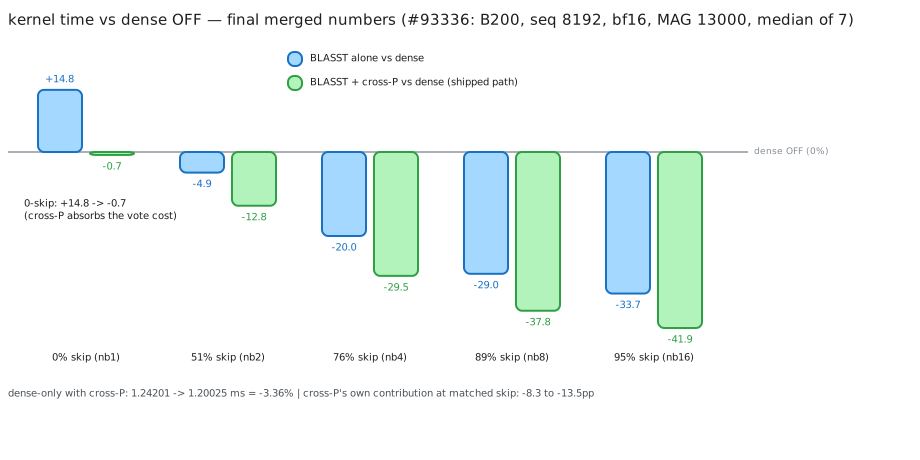
Three observations. Cross-P helps at every skip rate, by a roughly constant amount (last column). It turns the 0-skip tax into a small net win, which is what makes BLASST safe to leave enabled. And skip counts match at every threshold — cross-P changes what the kernel does while deciding, not which blocks get skipped.
At the model level (Llama-3.1-8B-Instruct), TTFT at 64K context falls 20.0% at a threshold where RULER accuracy lands above the dense baseline. The rest of the post derives this table.
FlashAttention
Attention is matmul → softmax → matmul: scores , weights row-wise, output . The full score matrix is too big to materialize. FlashAttention therefore streams K/V in blocks (128 keys per block here) and keeps three running statistics per query row: a running max (you exponentiate for stability), a running sum of exponentials , and the output accumulator . A running max creates a correction step: when a new block raises it, prior accumulation is rescaled by ; if the max doesn’t move, the factor is exactly 1 — a no-op.
MAX’s FA4-style SM100 kernel
(max/kernels/src/nn/attention/gpu/nvidia/sm100/) is warp-specialized — a
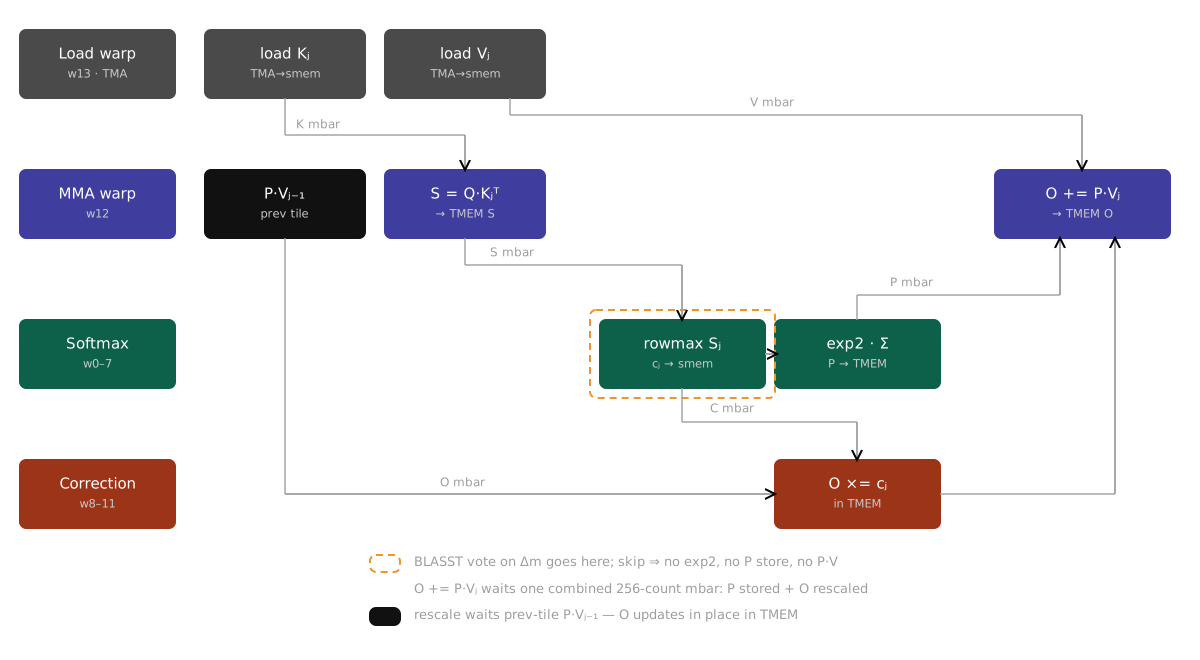
pipeline of roles over KV blocks :
- the load warp TMAs / from HBM into shared memory;
- the MMA warp issues every tensor-core matmul: into TMEM (SM100’s on-chip accumulator memory), and later ;
- two softmax warpgroups, one query tile each — the “2Q” split — read S out of TMEM, take the row max, compute exp2, store P back to TMEM;
- the correction warpgroup rescales in place.
Why two query tiles? Each tile’s QKᵀ → exp2 → P·V is a dependent chain, and
during exp2 the tensor cores would idle. The tiles share only the streamed
K/V, so each tile’s exp2 hides behind the other’s matmuls.
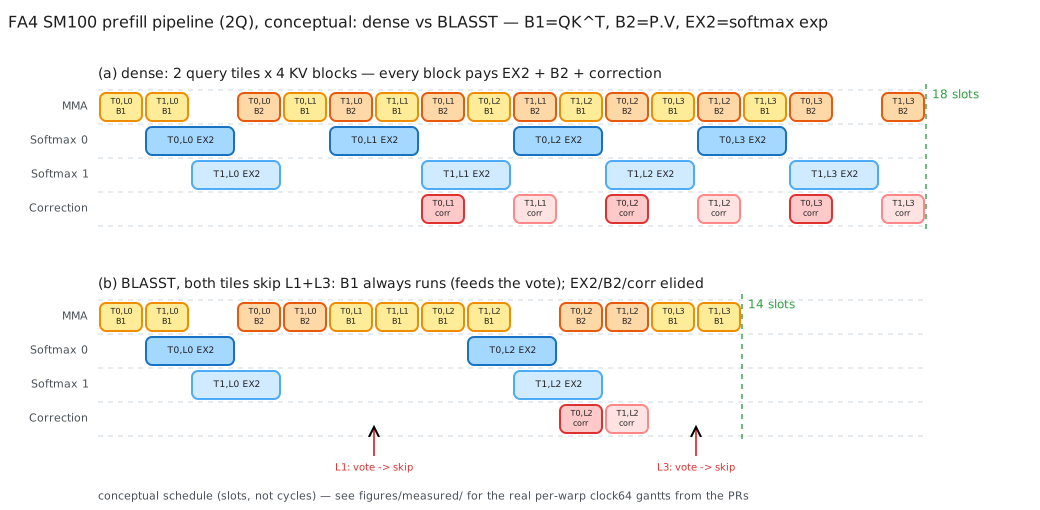
That schedule is static. BLASST empties slots out of it.
Vote, then skip
During online softmax you already hold a block’s local max and the running max . The BLASST rule: if
then every post-softmax weight in the block is at most — negligible — so its exp2, row-sum, P store, and matmul can all go. A skipped block never raises the running max, so its correction factor is exactly 1.0 and the running statistics stay exact. One scalar controls everything.
Prefill is compute-bound, so the win is the removed exp2/FP math and P·V tensor-core work — V still gets loaded. The real kernel work is turning a per-row test into a per-block skip: exp2 and P·V execute collectively, 128 rows per warpgroup, one monolithic matmul. The test also needs a true running max, so a second one exists solely for the vote — the kernel’s own is lazy.
As landed:
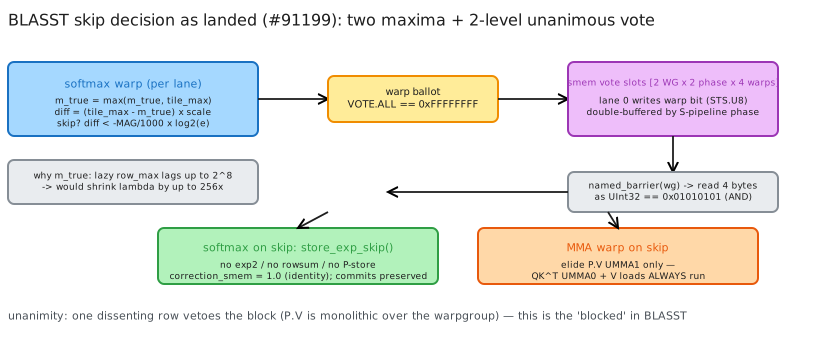
- Warp ballot, vote-ALL. Each lane tests its rows;
VOTE.ALLANDs 32 lanes in one instruction. One row that wants the block vetoes the skip — that unanimity is the “blocked” in BLASST. - Warpgroup unanimity via smem. Lane 0 of each warp publishes its bit to
a shared-memory slot; after a warpgroup
named_barrier, all 128 threads read the four bits back; the skip needs unanimity. - On a skip. A stripped
store_exp_skipruns — no exp2, no row-sum, no P store, correction written as identity — and every mbarrier arrival is preserved so the pipeline never desynchronizes. The MMA warp elides only the P·V. and the V loads always run: the scores feed the decision itself, which also caps prefill speedup near 1.8× regardless of sparsity.
The scoreboard says the sparsity arrived and the time didn’t; seeing why takes instruments.
The instruments
Per-warp clock64 timelines: gated instrumentation stamps every warp’s step
boundaries; one recording CTA’s stamps render as a gantt: one row per
warp, one colored span per step.
The instrument perturbs what it measures and is only common-mode within one build. So the standing rule: gantts for structure, NCU and md5-witnessed benchmarks for magnitudes.
Nsight Compute (base clocks, matched md5-witnessed binaries) frames everything with its first result. Dense at 64K context: SM compute throughput 89.6% of peak, memory not the constraint — the kernel is compute-bound.
At 94% skip, exp2 instructions fall 93.8% while TMEM score reads (LDTM)
stay byte-identical — BLASST wins by deleting the pacing compute. The problem
was everything around it.
Evidence, part 1
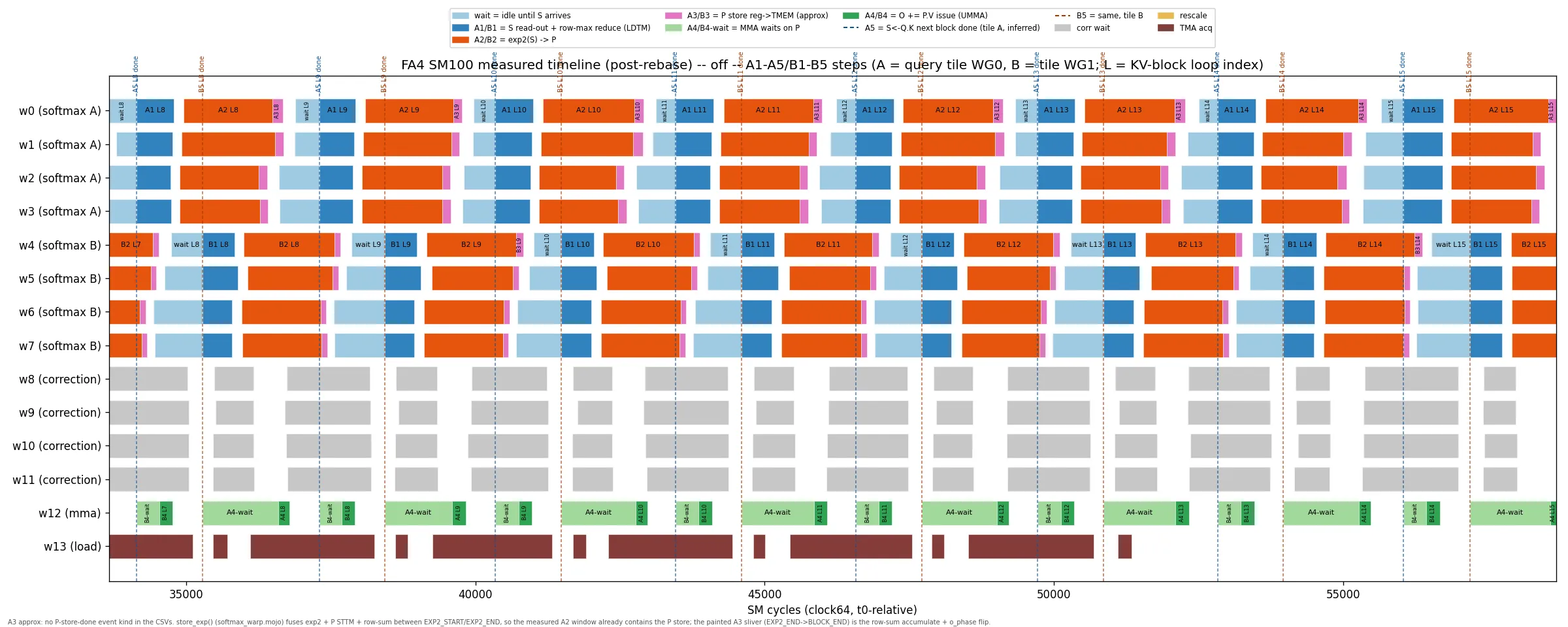
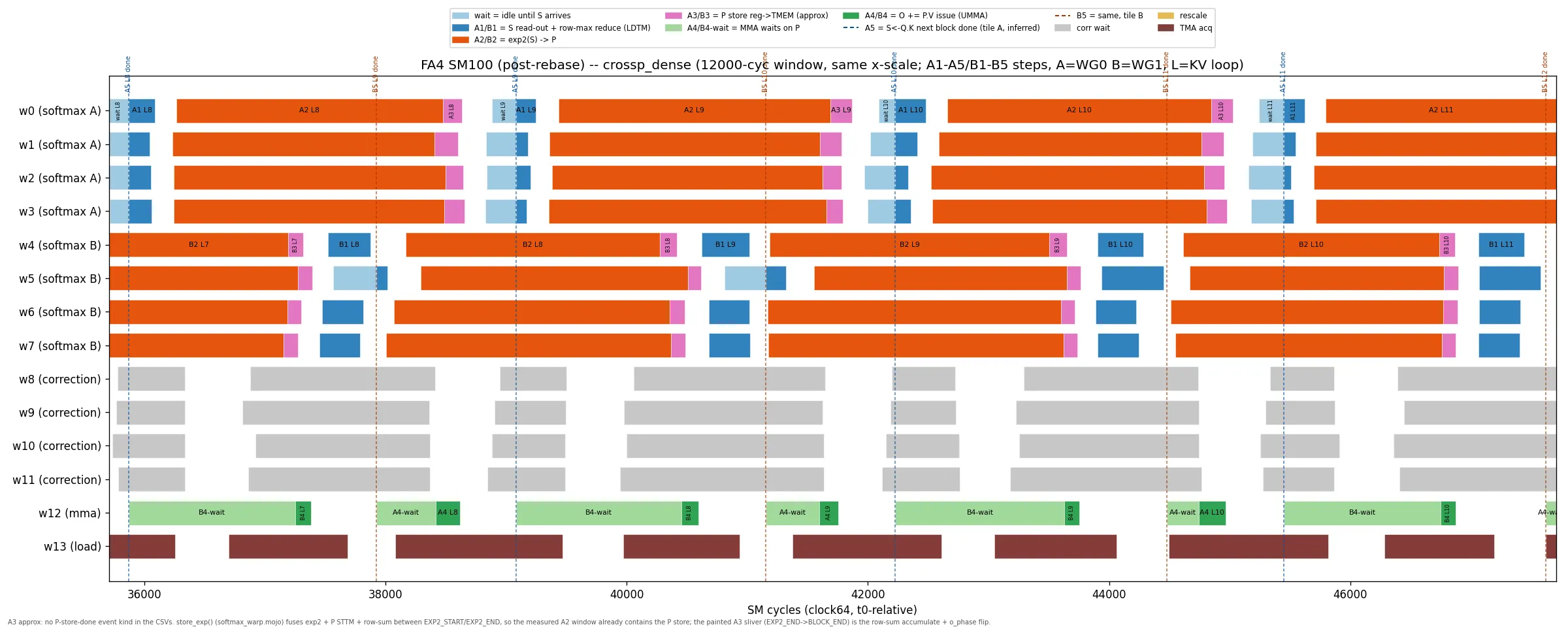
Dense, everything off:
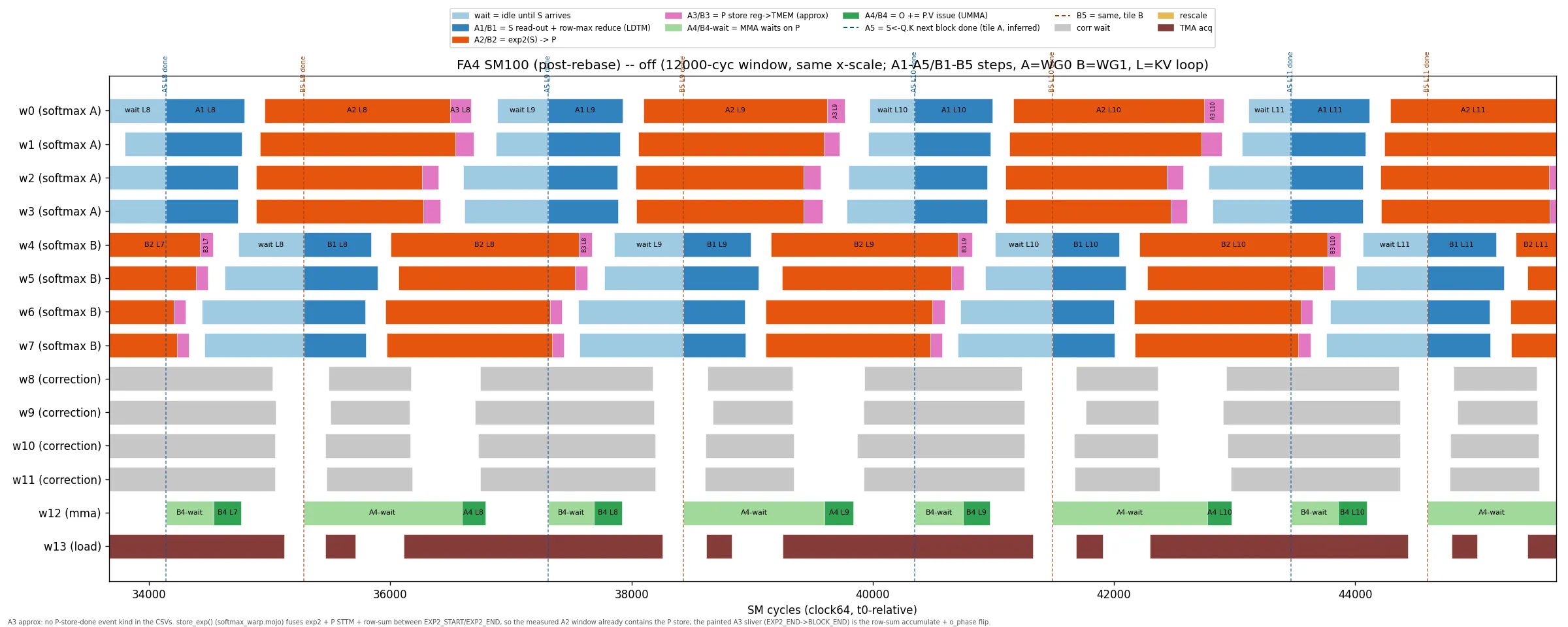
Two readings. Exp2 (orange) is the long pole on the softmax lanes — consistent with NCU. And every block on every softmax warp begins with a light-blue wait for scores. In steady state, S lands roughly 800 cycles after the previous block’s exp2 ends — early on 0 of 62 measured blocks. Scores are always just-in-time. Dense doesn’t much care; the wait hides behind other work.
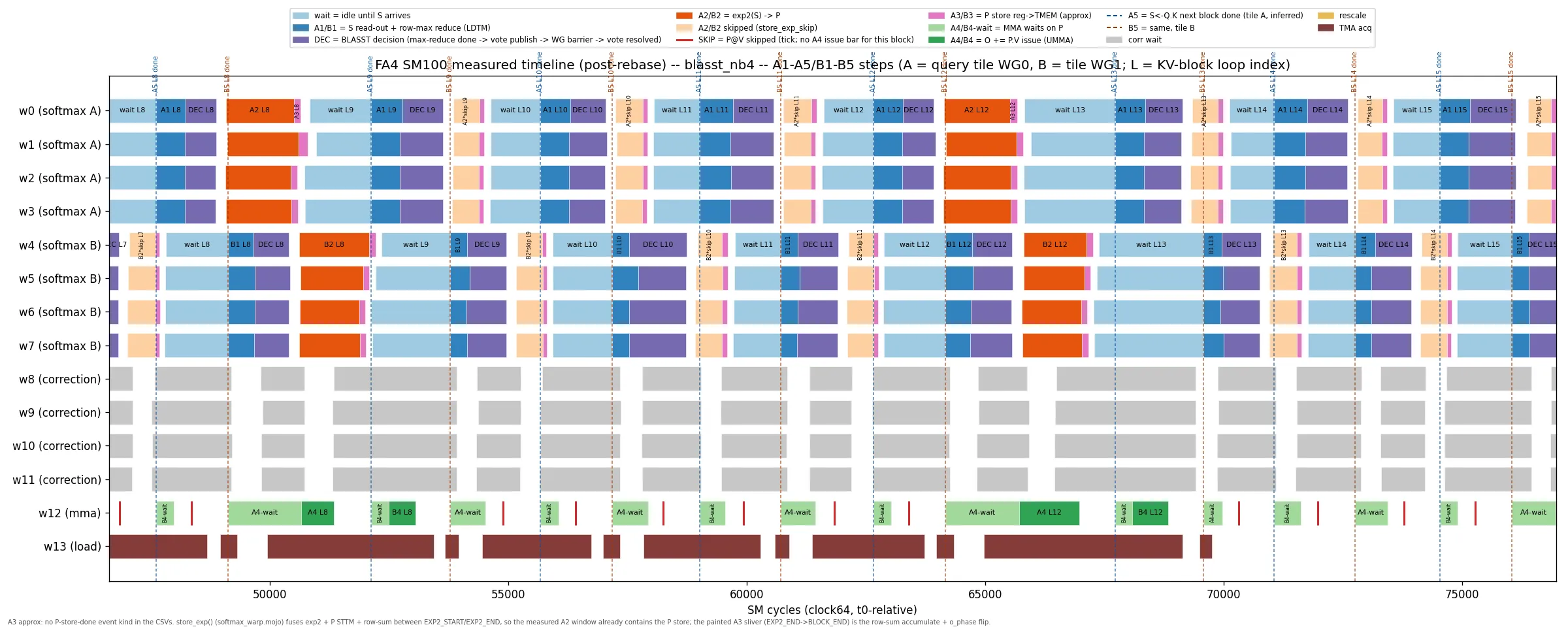
Now BLASST at 76% skip (nb4), no cross-P:
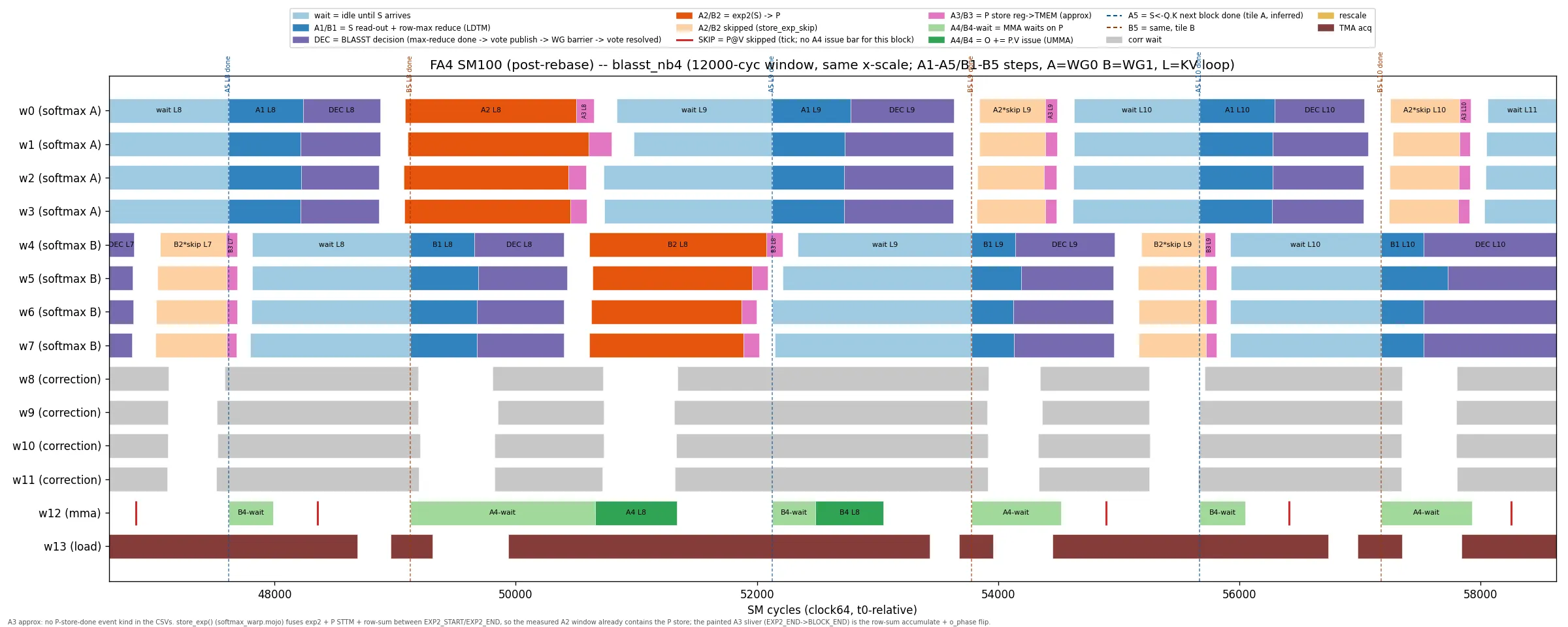
The machinery works: purple DEC spans follow each A1, skipped blocks collapse to pale slivers, red ticks mark elided P·Vs. But light blue now dominates the softmax lanes. The kernel deleted most of its exp2 and turned much of the saving into waiting. A skipped block runs wait → A1 → DEC → skip, and the wait is the biggest piece.
Two questions remain, and they share an answer. Why does BLASST cost +14.8% when nothing is skipped? And why does deleted work turn into waiting instead of wall-clock time?
The 0-skip tax
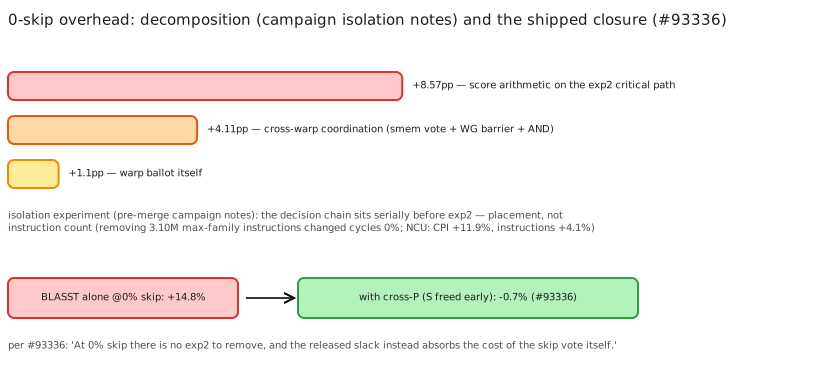
The 0-skip question first; NCU answers it definitively. The vote adds instructions on the softmax lanes. The obvious hypothesis: too many of them. So I deleted some — a cleanup collapsed the tile-max reduction from two full fragment reductions to one, removing 3.10M max-family instructions, the single largest adder. Cycles moved 0%. The instruction count fell, CPI rose to compensate, and their product held constant to three decimals. The instructions were free.
The cost is where they sit: the decision chain
LDTM (read S) → max reduce → compare → warp vote → smem write → WG barrier → readback → branchexecutes serially between the score read and exp2, on the softmax critical
path — roughly 712 cycles per block (instrumented captures). NCU’s stall view
agrees: the dominant delta is long_scoreboard where the lengthened chain
resolves — the vote exposes a pre-existing UMMA→S-read latency that used to
hide.
So where does the tax sit? Mostly in score arithmetic on the exp2 path — about 8.6 points of the ~14 (bench-isolation decomposition, figure), not coordination.
I falsified the cheap fixes one by one:
| Lever | Result |
|---|---|
| Delete the redundant reduction (−3.10M instr) | perf-neutral — the instructions were latency-hidden |
| Drop the warpgroup barrier (per-warp strips, zeroed P) | recovered ~1.1pp of ~14; raised break-even to ~47% skip |
| Skip only the P·V, leave softmax alone | +8.5% slower at 75% skip — P·V was never on the critical path (~2.3%) |
| Offload the decision to the idle correction warps | dead on inspection: correction wakes at the same S-ready signal — no head start |
The note I wrote at the time: an on-critical-path decision bottoms out around +8–10% no matter how much coordination you shave. To get the paper’s “0-sparsity ≈ free,” the decision must leave the critical path — or the path must move.
Why the waits stay
So what’s keeping the scores late? The gantt already showed it: scores are late by construction.
TMEM is fully budgeted, so P has nowhere of its own; by default each tile’s P overwrites its own S region. P holds S hostage: the buffer can’t accept block ’s scores until block ’s P, in the same columns, has been stored and consumed by P·V. If we trace one tile:
QK(i) → read S(i) → exp2 → store P(i) over S(i) → P·V reads it → only now QK(i+1)The next score matmul is chained, transitively, behind this block’s exp2, P store, and P·V. That’s why S always lands just-in-time. Dense mostly gets away with it — exp2 is long enough to cover the chain. But BLASST deletes exp2, and what remains on a skipped block is exactly what the chain gates: waiting for scores, then a vote about them. The skip removes the work that was hiding the latency and keeps the latency.
The same chain explains the 0-skip tax’s stubbornness — the vote sits inside the one serial dependency with no slack — and predicts the fix. Nothing about the decision needs to change. The S buffer must be free the moment its scores are read out, so the next QKᵀ can start underneath everything else. P needs to go somewhere else. There is no spare TMEM. But there are the sibling’s columns.
Cross-stage P
Where can P go? P is bf16, so a 128-wide P row packs into 64 of an S region’s
128 f32-sized columns — and after readout, an S region is dead data.
Cross-stage P changes only where P is written: tile A’s P goes into tile B’s
S region and vice versa (S0[0:64) = P1, S1[0:64) = P0, upper halves
stale).
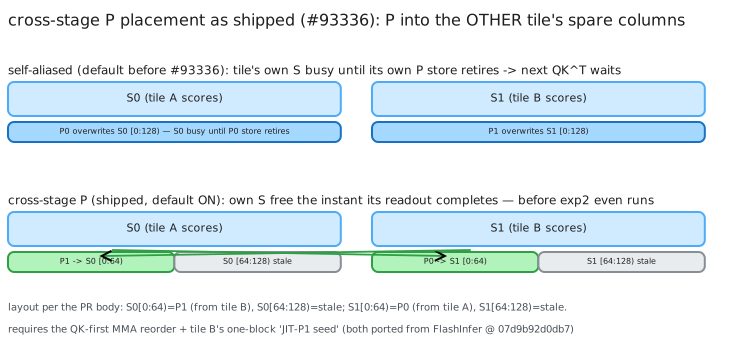
Now a tile’s score buffer is free the instant readout completes — before exp2 even runs — so the next score matmul starts right away. The exp2/store/P·V tail runs beside the next QKᵀ instead of in front of it. Moving one address breaks an implicit safety net, so three things move with it:
- The MMA issue order goes QK-first. The default order put each tile’s next QK behind its own P·V in program order — that was the write-after-read fence protecting P. Both score matmuls now issue first, each QK gated by a cheap “softmax finished reading S” mbarrier instead of a full P drain.
- A JIT-P1 seed. One hazard survives: tile B’s P now lives in S0, and QK0 is the first op of the next iteration — it would clobber P1 before its P·V read. The fix makes tile B’s store late rather than guarded: warpgroup B consumes one extra “window free” token before its main loop — a one-block head start, so its store lands after the next QK0’s scores are read out. Both pieces — order and seed — come from FlashInfer.
- A tuned store schedule. P can only be stored once the sibling’s window
is free (an
inplacehandshake), so each tile buffers some exp2 output in registers to cover the gap. An exhaustive md5-witnessed sweep: buffer nothing and the store stalls on the flag (+5.99%); buffer everything and exp2 stops overlapping the stores (up to +11.44%). Shipped: tile B fully fused — its window frees before its exp2 even starts, thanks to the half-period stagger — and tile A buffers a quarter.
BLASST plugs in unchanged: the skip path consumes its handshake token per block even when storing nothing, keeping the pipelines in phase.
I had built this exact mechanism three weeks earlier and measured a loss:
+1.44% on dense, the intended “S arrives early” gain ≈0. The post-mortem also
found a real race in its cross-warpgroup handshake — isolated launches
verified 12/12; back-to-back launches failed about 1 in 5. I archived the
diff and wrote “falsified.” Then an unrelated MMA-layout rewrite landed on
main and changed the kernel’s latency-hiding shape. Re-measured on top of
it, the identical placement was a clear win; retuned (the sweep above), with
depth-4 handshake pipes, it shipped. The lesson, verbatim from my notes:
“‘inherent’ verdicts are relative to a kernel shape — re-test falsified
levers after major upstream rewrites.”
Evidence, part 2
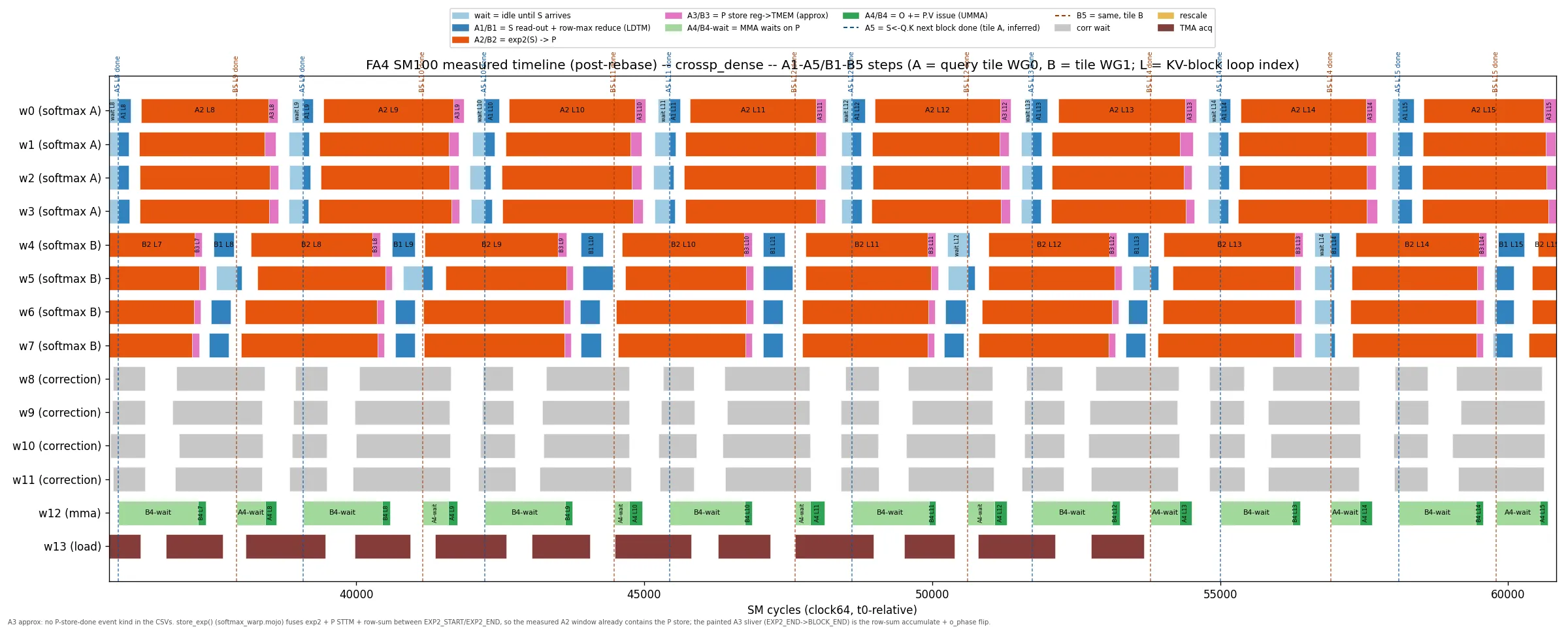
Cross-P alone, dense inputs, BLASST off:
Same axes as the dense baseline: the light-blue waits have all but disappeared — the next block’s scores are computed underneath the current block’s softmax, exactly the slack the layout was supposed to buy.
On the bench: 1.24201 → 1.20025 ms, −3.36% on dense — which is why cross-P ships default-on, BLASST or no. The NCU matched pair reads as a pure scheduling win — the same matmul work, packed tighter.
And both together — BLASST nb4 + cross-P:
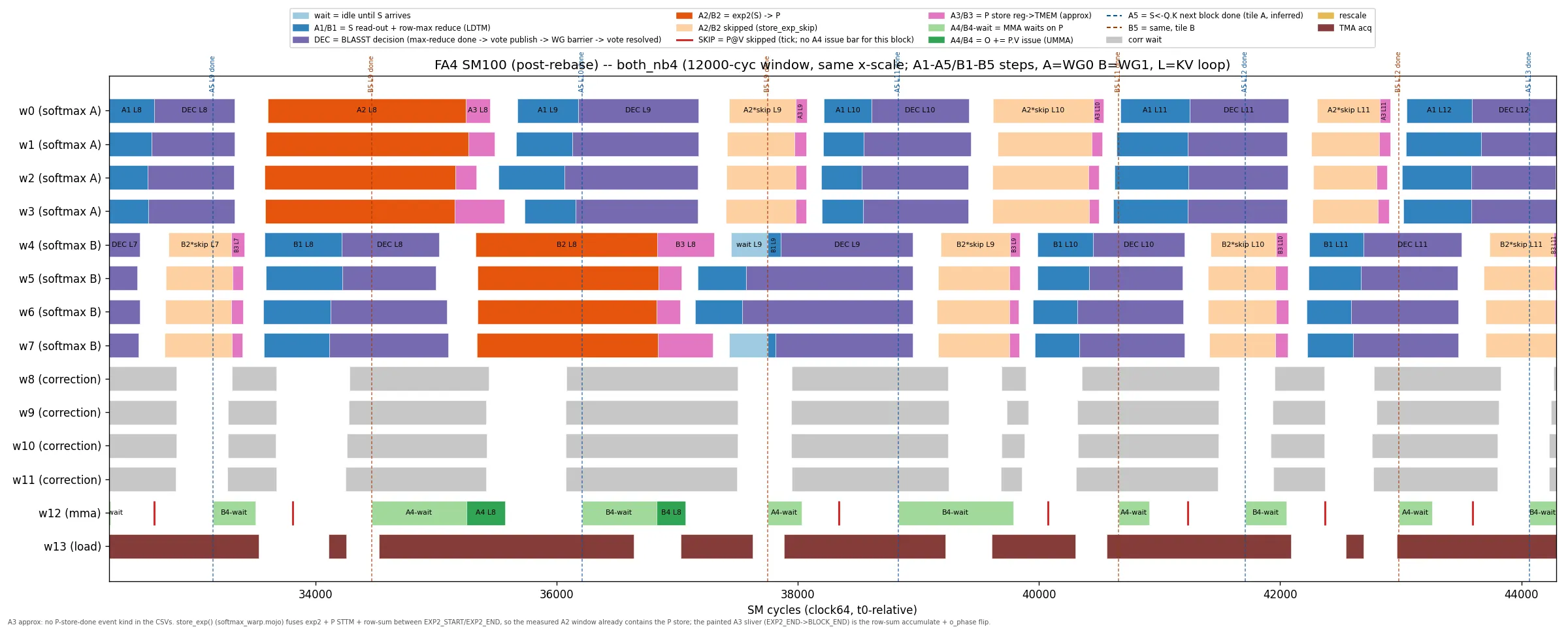
Against the BLASST-alone gantt: same DEC spans, same skip slivers, same red ticks — the vote is untouched — but the light blue is gone. Skipped blocks run A1 → DEC → skip back-to-back, and visibly more KV blocks fit in the same 12,000-cycle window.
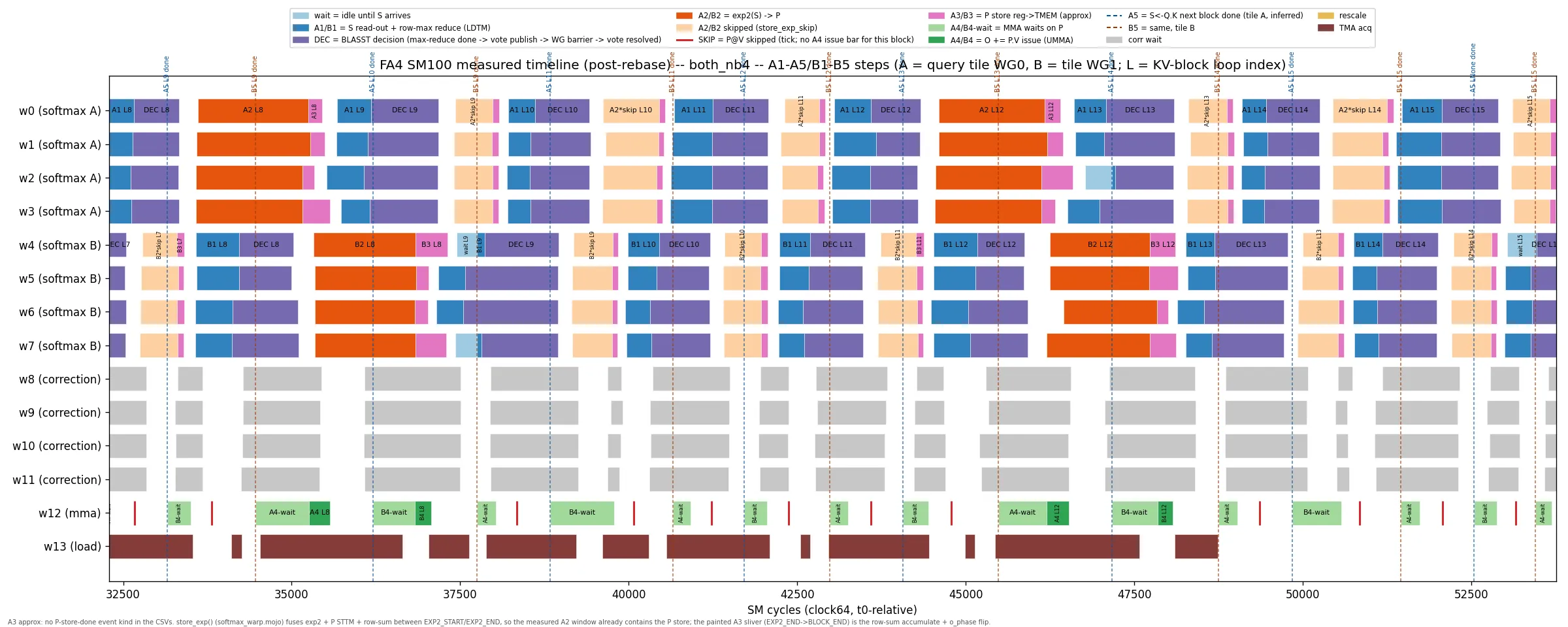
Why does cross-P help more under BLASST than on dense — −12% vs −3.4%? On dense, exp2 still dominates, so early scores mostly convert waiting into slack. With skipping, exp2 is deleted and score latency is the critical path — precisely what the early release shortens.
At 0% skip there is no exp2 to remove, so the released slack simply absorbs the vote chain: +14.8% becomes −0.7%. The tax is gone.
From kernel to model
Does any of this survive end to end? Attention is only part of prefill — TTFT gains are diluted by unchanged MLP, norm, and embedding work — and accuracy decides whether any of it ships. Setup: Llama-3.1-8B-Instruct, bf16, single B200.
| MAG | RULER avg | RULER 64K | TTFT 4K Δ | TTFT 64K Δ |
|---|---|---|---|---|
| dense | 81.9 | 78.5 | ref (44.3 ms) | ref (1194 ms) |
| 14000 | 81.9 | 78.5 | −0.5% | +3.8% |
| 10000 | 81.7 | 77.4 | +1.1% | −4.1% |
| 7000 | 82.6 | 78.2 | −2.7% | −8.6% |
| 4500 | 82.2 | 77.7 | +2.5% | −13.7% |
| 2500 | 82.7 | 75.2 | −3.8% | −20.0% |
| 1500 | 79.6 | 69.6 | −4.3% | −20.9% |
| 1000 | 71.8 | 58.2 | −6.8% | −21.9% |
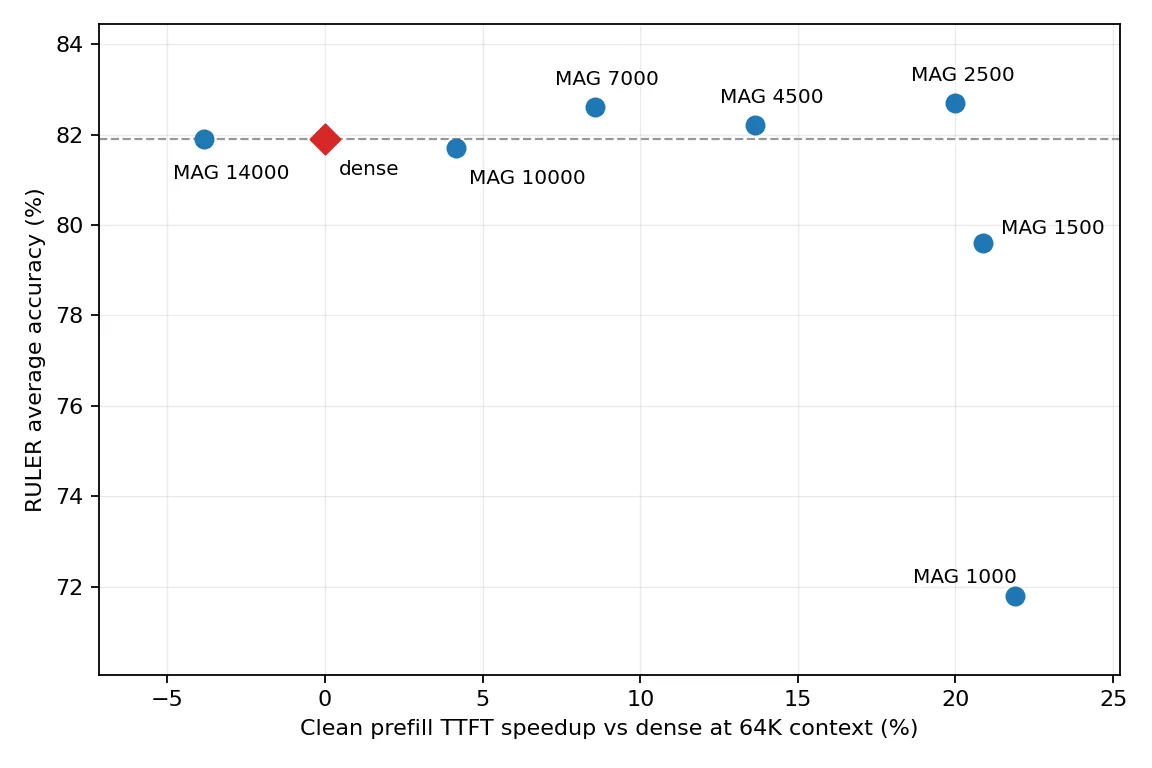
Accuracy holds from the strictest threshold down to MAG 2500, which posts the best average — above dense — while cutting 64K TTFT by a fifth. Below MAG 1500, accuracy falls off a cliff, long context first.
It’s a long-context lever: at 4K the deltas sit within a few percent either way — nothing worth skipping — and the win grows with context. Too conservative is also wrong: MAG 14000 is slower than dense at 64K, because nothing clears the threshold and the vote runs with nothing to remove.
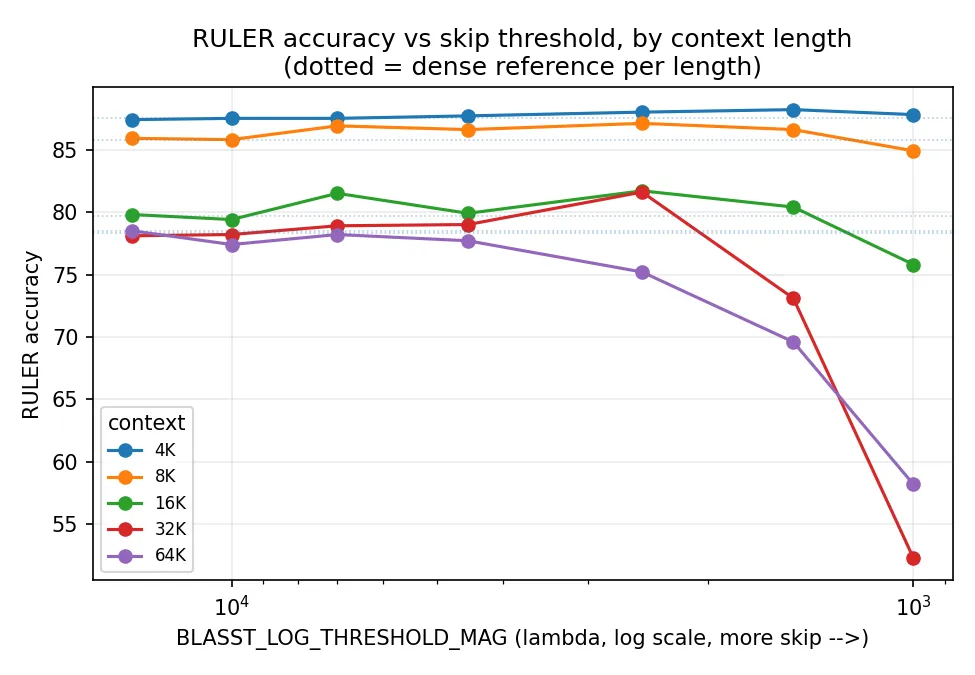
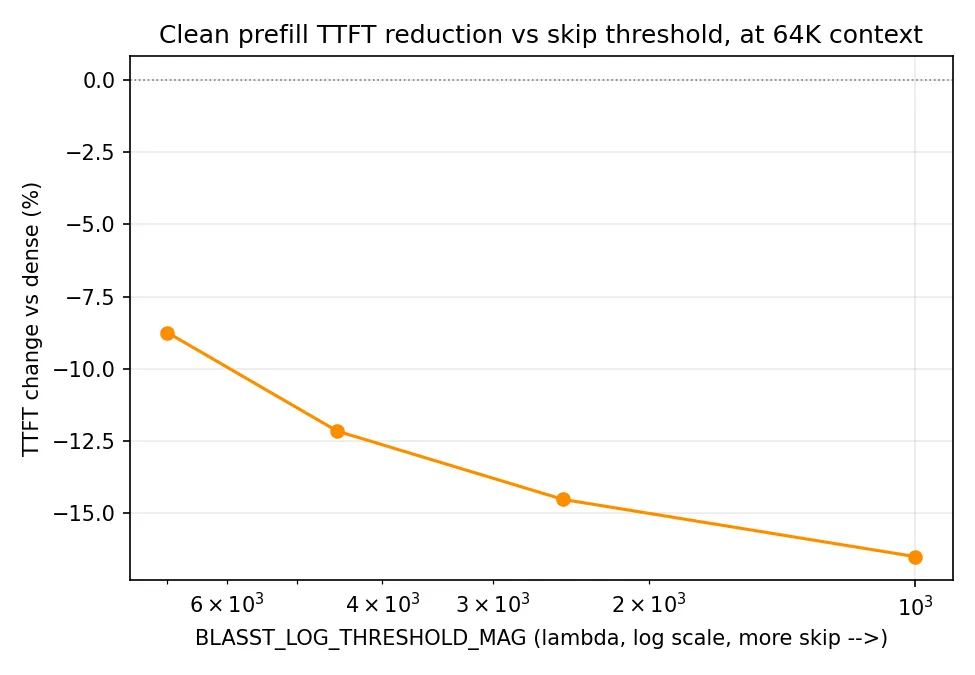
The PR recommends MAG 2500 (best average) or MAG 4500 (64K-lossless, table above).
Trusting the numbers
Sparse-attention kernels fail quietly — plausible-but-wrong outputs, races that only show under load — and this project ate one such race early. Every number rides a stack of gates: bit-exact reference agreement, launch-pressure soaks, sanitizer-clean runs, md5-witnessed ON-vs-OFF pairs. Disabled, BLASST cannot perturb the shipping kernel: the OFF build is byte-identical (md5).
Where I landed
BLASST ships opt-in; cross-stage P ships default-on. Together on the FA4 SM100 bf16 prefill kernel: −41.9% attention-kernel time at 95% skip, −0.7% at 0% skip, and −20% TTFT at 64K with RULER accuracy above the dense baseline.
Two lessons cost the most. Count cycles, not instructions: deleting 3.10M instructions moved cycles 0%. The tax was placement — a short chain in the wrong place beats a long chain in the right one. And falsified is a property of the baseline: the same cross-P mechanism measured a loss in July and a win in August, separated by an upstream rewrite. Re-test your graveyard. The third generalizes: a skip optimization is a latency-hiding audit — whether removed work becomes wall-clock depends on what it was hiding. The gantt showed what no counter did.
One item stays open: the absolute-RULER gap against the paper’s scores — presumably serving-harness fidelity; the relative comparisons stand either way.
Thanks to Modular for giving “the skip works but the speedup is missing” the weeks it needed, and to my mentor Chris Elrod, who runs GPUs in his head.
If your attention kernel is about to grow a skip path, move the decision off the critical path first, and budget as much time for the schedule as for the math. And if you’ve measured an in-path vote that came out free at 0% sparsity, I’d like to see it.